


A key element of being a specialist in medical practice is the ability to lead and manage both within the Emergency Department and in partnership with other specialties and organisations. It is a GMC requirement that all those training to UK Royal College curricula develop such skills.
Domain 1: Professional values and behaviours
Domain 2: Professional skills
- practical skills
- communication and interpersonal skills
- dealing with complexity and uncertainty
- clinical skills (history taking, diagnosis and medical management; consent; humane interventions; prescribing medicines safely; using medical devices safely; infection control and communicable disease)
Domain 3: Professional knowledge
- professional requirements
- national legislative requirements
- the health service and healthcare systems in the four countries
Domain 4: Capabilities in health promotion and illness prevention
Domain 5: Capabilities in leadership and teamworking
Domain 6: Capabilities in patient safety and quality improvement
- patient safety
- quality improvement
At completion of Intermediate training a trainee will:
- be able to demonstrate their involvement in one or more core management activities and show an understanding of the relevant medicolegal directives
- be able to describe the difference between leadership and management.
- demonstrate an understanding of how the development of one’s own leadership abilities positively impacts upon one’s own wellbeing and ability to function as an individual and as a leader
At completion of higher training a trainee will:
- be able to demonstrate their involvement in a range of management activities and show an understanding of the relevant medicolegal directives (elements not completed in intermediate)
- be able to investigate a patient safety incident, participate and contribute effectively to department clinical governance activities and risk reduction projects
- be able to manage the staff rota, being aware of relevant employment law and recruitment activities including interviews and involvement in induction
- be able to effectively represent the ED at inter specialty meetings
- demonstrate an understanding of how effective Emergency Medicine Leadership positively impacts on standards of patient care and patient safety whether through leading Resuscitation Teams, leading the Shift or leading in the Trust and wider Healthcare System
- demonstrate a positive impact on the culture of the Emergency Department through attitudes and behaviours that impact positively on colleagues, patients and their relatives
- Responds to complaints in a variety of formats including verbal response, written response and face to face meetings
- Constructs a report for the coroner/procurator fiscal and/or legal services using information available from clinical notes
- Effectively participates, and supports others involved, in a patient safety incident investigation and be familiar with some of the tools involved such as RCA/ 5 Whys/Fishbone analysis
- Represents the ED in divisional / inter specialty /hospital committee meeting meetings such as clinical governance, resuscitation, transfusion, trauma etc. and feed back to the ED team
- Participates in the rota management ensuring adequate skill mix and cover
- Participates in multidisciplinary recruitment for the ED 57
- Aware of the interplay of various agencies in the NHS and how they interrelate in the evolving NHS Landscape
- Demonstrates a high level of communication skills in all of the above
- Demonstrates the professional values expected of an Emergency Medicine Doctor including the demonstration of high levels of integrity and trust and the need to demonstrate good time management skills, engagement with lifelong learning and the principles and value of reflective practice
- Possesses self-awareness and how an understanding of one’s own core values and beliefs impacts one’s behaviour and interactions with others
- Demonstrates emotional intelligence and resilience alongside an awareness of how factors such as tiredness and stress impact on our behaviours and how to mitigate these
- Has an understanding of how teams work and what makes a team function effectively and why teams may not work
- Appreciates the importance of followership and how followership behaviours impact upon an individual’s ability to lead and the performance of teams
- Has a basic understanding of health care systems and how they interact with the Emergency Department and start to develop the ability to analyse and understand specific systems and how to influence throughout health care systems
- Demonstrates progression of leadership knowledge, skills and behaviours with understanding of areas of strengths and those needing development
- Appreciates the importance of a positive culture within the Emergency Department and wider health care systems, including civility and the principles of ED&I, and how an individual’s leadership behaviour impacts upon culture
- Understands modern (medical) leadership theory to include concepts of compassionate leadership and distributive leadership
- Able to demonstrate an understanding of the differences between feedback, debriefing, mentoring and coaching through an understanding of how to effectively communicate
- The ability to lead, manage and administer is within the Programme of Learning during intermediate and higher training, and the requirements of the curriculum reflect growing expertise and responsibility in this subject over time.All activity and resources relating to the ability to lead and manage are relevant. For material that is specific to the EM environment, the EM Leaders framework and the EMLeaders modules are key resources for providing material to access for trainees and trainers in developing skills in leadership and management.Details and links for Leadership and management resources can be found in the Resources section of this SLO.The following (non-exhaustive) list gives examples of relevant activities:
Training certification:
- EMLeaders modules
- Equality, diversity & inclusivity
- Information governance and data protection
- Unconscious biases
- Active bystander
Face to Face courses:
- Leadership and management
- New consultant preparation
Experiential learning (mandatory in bold italics):
- Patient Safety Incident investigations
- Rota management, recruitment, induction
- Inter-specialty meetings
- Complaints meetings and report writing
- Appraisal of colleague
- Clinical governance meetings and activities
- Introduction of a guideline, equipment or service
- Organising training events
- Writing reports and business cases
The Assessment Schedule for the RCEM curriculum has been developed to best meet its aims and objectives. Two of the educational principles that have been considered in developing EM capabilities have been ‘spacing’ and ‘Interleaving’. These terms mean that there is likely to be better retention of knowledge and integration of curriculum elements if they are introduced early and revisited for reinforcement, and if the layering of greater complexity is interspersed with other curricular content.
The GMC require all curricula to include the ability to lead and manage in all stages of training as part of their Generic Professional Capabilities. The development and application of the underpinning knowledge and skills starts in ACCS and builds throughout training.
Leadership and management are formally set out within the Programmes of Learning and Assessment from intermediate training onwards and the requirements of the curriculum reflect growing expertise and responsibility in this subject over time.
How is this SLO assessed?
Assessment in the workplace
Trainees are expected to undertake a minimum of one leadership/management activity in each year of intermediate and higher training. It is recognised that the overall extent of such activity may vary to a degree year-by-year according to trainees’ activity against the other generic SLOs.
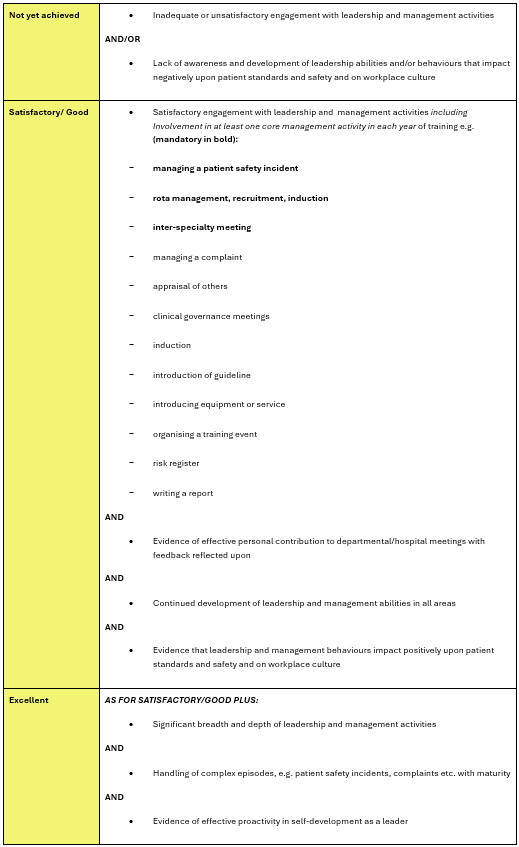
During higher training there should be evidence of continued development of leadership and management abilities and engagement in related activities including the three mandatory ones – patient safety incident investigation, rota management/recruitment/induction and inter-specialty meetings. By the end of training trainees are required to provide sufficient evidence to at least a satisfactory standard for all six Key Capabilities.
All activity relating to leadership and manage,ent is relevant and the list of evidence that might be used is not reductive in any way. Some trainees may be inspired by the topic and seek to stretch further in this area. The following tools and opportunities are available to gain formative feedback on the Key Capabilities of this SLO:
Leadership Assessment Tool (LAT)
Formative assessment will include feedback on elements of these activities. For the majority of activities, the Leadership Assessment Tool (LAT) should be used to capture details of the activity and supervisor feedback.
EMLeaders modules
Completion of the EMLeaders modules on Self, Teams and Systems (or equivalent) are also required by the end of intermediate training.
Other evidence
Further evidence of leadership and management engagement and feedback on performance may be collated using the following:
- MSF
- ESLE
- Reflections
- Course/module certificates
Educational review
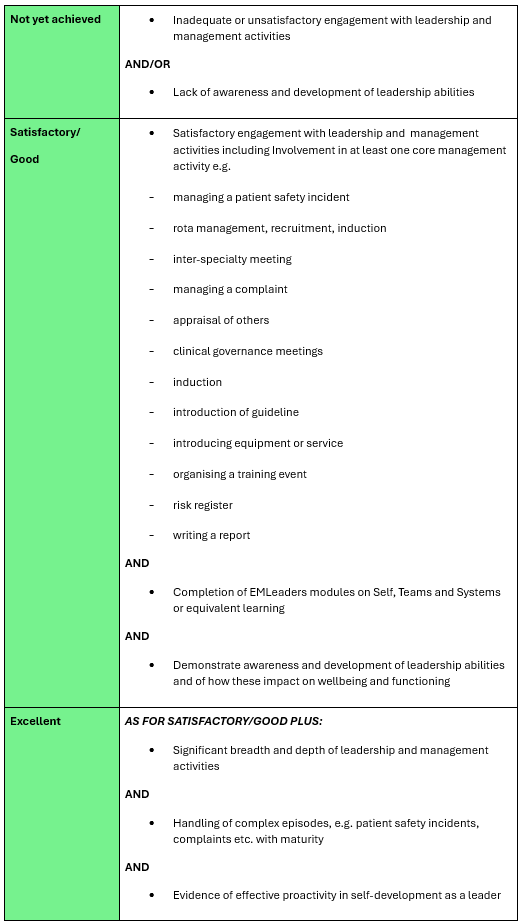
Summative assessment at the end of intermediate training is a judgement by the Educational Supervisor and recorded on the Intermediate ESR form, with subsequent overview from the ARCP panel. By the end of intermediate training, trainees are required to provide sufficient evidence to at least a satisfactory standard for the three key capabilities of this SLO.
Standard required
The following table summarises the activity that is expected and how excellence might be pursued:
End of Intermediate:
Educational review
Summative assessment in each year of higher training is a judgement by the Educational Supervisor and recorded on the Higher ESR form, with subsequent overview from the ARCP panel. There is a requirement for progression year on year towards the elements described. It is possible to progress through these more rapidly if trainees have a particular interest or opportunities in this SLO. By the end of higher training, trainees are required to provide sufficient evidence to at least a satisfactory standard for the six key capabilities of this SLO.
RCEM examinations
The content of this SLO is also assessed in the formal examination schedule.
FRCEM SBA
There are questions in the FRCEM SBA which assess the underpinning knowledge required to lead and manage.
FRCEM OSCE
The FRCEM OSCE is blueprinted to include stations that cover the complex or challenging situations an EM clinician will face, including the requirements of leadership and support within the ED.
Standard required
The following table summarises the activity that is expected and how excellence might be pursued:
End of Higher:
RCEM EM Leaders Programme
https://rcem.ac.uk/the-em-leaders-programme/
EMLeaders Framework
https://rcem.ac.uk/wp-content/uploads/2021/10/EMLeaders_Framework_vs.3_100521.pdf

